Fork bottoming out: when it is normal
A fork that bottoms out occasionally on the biggest hit of a run is normal; RockShox aims for most of the travel used regularly with occasional bottom-outs on large impacts. Bottoming out on ordinary bumps, or repeatedly in one section, means too little spring or end-stroke support, fixed in 5 PSI steps.
Published
What bottoming out is
- Bottoming out
- The fork or shock reaching the end of its travel, where the bottom-out bumper or end-stroke damping stops it. Felt as a harsh, often audible knock when there is too little support left.
Travel that is never used is travel carried for nothing, so the target is not zero bottom-outs. RockShox aims for a soft but supportive feel, using most of the travel regularly with occasional bottom-outs on large impacts.
How often a fork should bottom out
| Pattern | What it means | What to change |
|---|---|---|
| Occasionally, on the largest impacts | The travel is being used as intended | Nothing |
| Repeatedly, on ordinary bumps | The spring is too soft for the rider or the terrain | Add 5 PSI at a time |
| Only on the biggest landing, harsh and loud | Too little end-stroke support | Adjustable bottom-out, where fitted |
| Never, deepest point far from the end | The spring is too firm and travel goes unused | Remove 5 PSI at a time |
RockShox's adjustable bottom-out gives its forks 8 clicks over the last 10 mm of travel, and its Vivid shock 5 clicks acting on the last 20%. Both change the end of the stroke without moving the sag.
What a recorded run shows at the end of the stroke
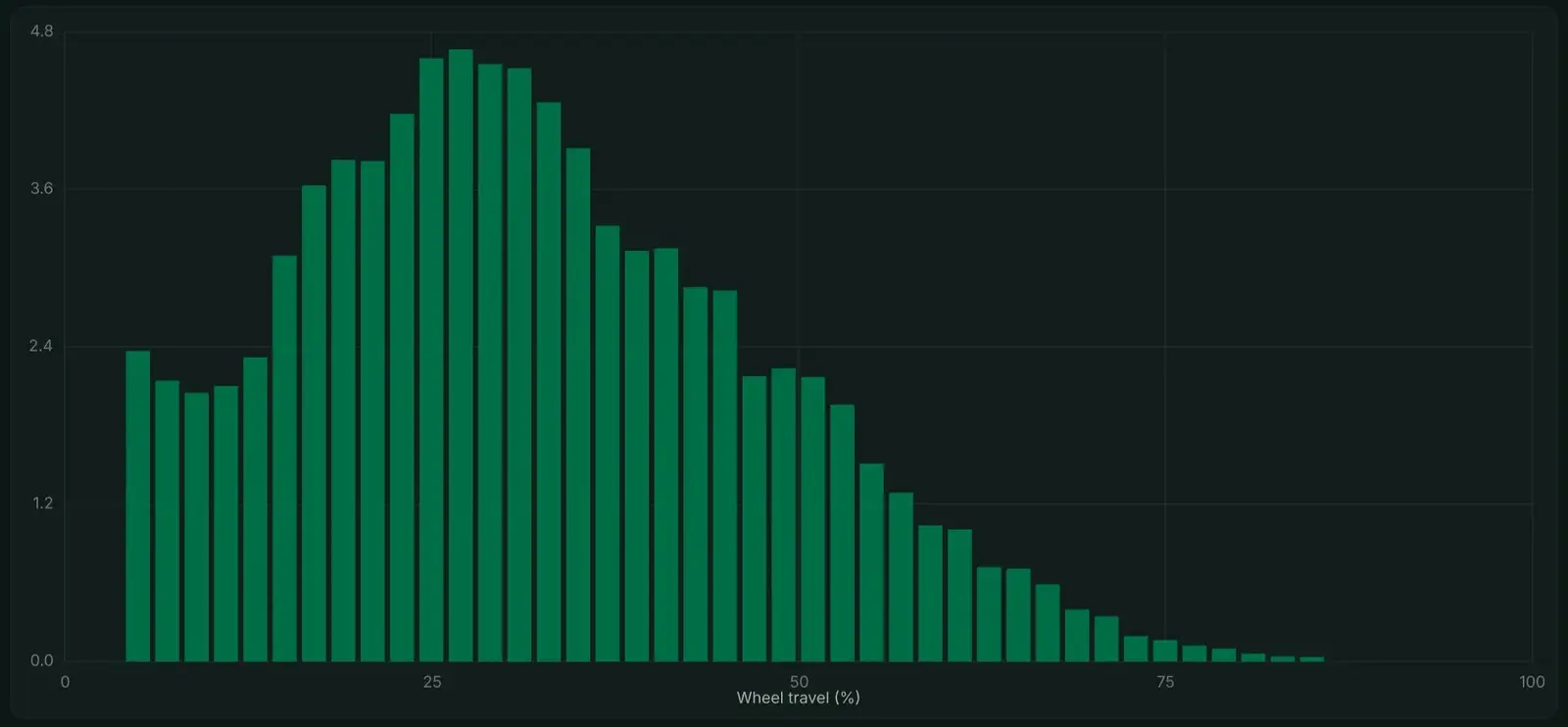
A travel histogram counts the time spent in each band of the stroke. Bottom-outs show as a spike against 100%, not as a long tail; a tail that stops short means the end of the travel went unused.
When the run also records GPS, each bottom-out has a place on the track. That is the section to ride again after the change, and the one to compare.
Auto tuning in the BYB Telemetry software gives bottom-out its own row for fork and shock. On the descent shown in compression and rebound at high and low speed, it suggested slightly less bottom-out resistance at the fork, which points the other way: toward using more of the travel.
How to fix a fork that bottoms out too often
- Check sag first: a fork with too much sag starts every hit deeper in its travel
- Add air in 5 PSI steps until bottom-outs are occasional rather than regular
- Recheck rebound after a 5–10 PSI change; RockShox pairs it with 1–2 clicks
- If sag is right and only the biggest hit is harsh, add end-stroke support with an adjustable bottom-out where the fork has one
- Ride the same section again and compare where the deepest point of the run sits
Sag is covered step by step in how to measure sag on a mountain bike. On a motorcycle, race sag and the spring check come first, as motocross and enduro suspension setup explains.
Common questions
- Is it bad if my fork bottoms out?
- Not occasionally. RockShox aims for most of the travel used regularly with occasional bottom-outs on large impacts. Repeated or harsh bottom-outs on ordinary terrain are the problem.
- How do I know if my fork is bottoming out?
- The o-ring pushed to the end of the stanchion is the simplest sign, but it records only the deepest point of the ride, not how often. A recorded run shows every time the fork reached the end of its stroke, and where.
- How much air should I add to stop bottoming out?
- RockShox's step is 5 PSI at a time, until the fork feels supportive and stops bottoming out too often. Check sag after each change so the bike still sits where it should.
- Can a shock bottom out too?
- Yes, and it is read the same way: a shock bottom-out shows as its travel passing 95%, and a run with GPS shows where on the track it happened.