Motocross and enduro suspension setup
Set up motocross and enduro suspension by setting race sag first, then checking static sag to confirm the shock spring, then adjusting compression and rebound clickers one at a time. Motocross Action's rule of thumb is 100 mm of race sag with 30–40 mm of static sag on 125, 250 and 450 bikes.
Published
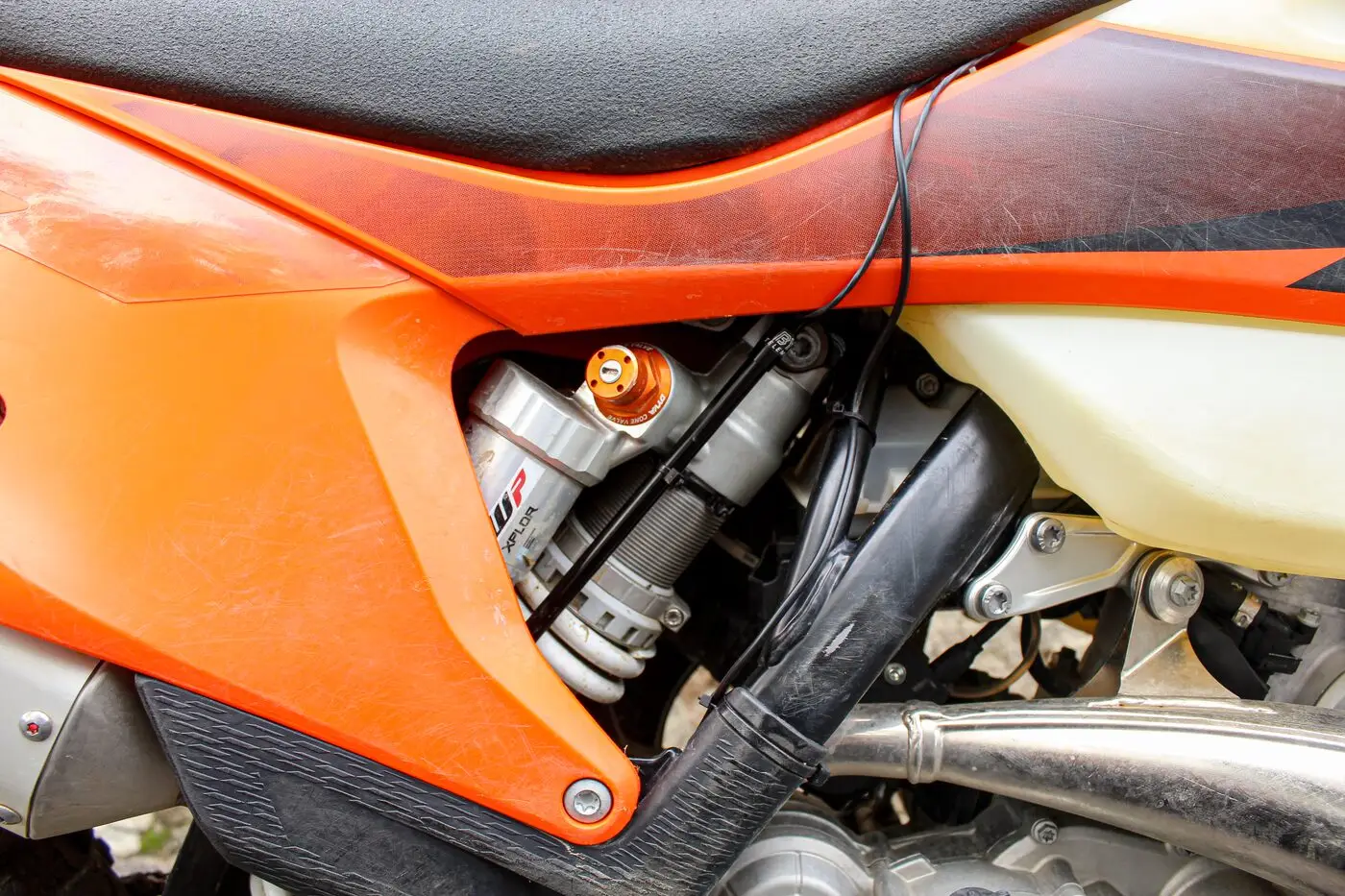
Race sag and static sag on a motorcycle
- Race sag
- How far the rear of the bike drops with the rider on board in full kit and riding position. Also called rider sag. It is set with shock spring preload.
- Static sag
- How far the rear drops under the bike's own weight, with no rider. Also called free sag. It is read after race sag is set, as a check on the spring rate.
| Measure | Figure | Source |
|---|---|---|
| Race sag, rule of thumb | 100 mm | Motocross Action |
| Race sag, most modern bikes | 100–108 mm | Precision Concepts, in Dirt Bike |
| Race sag, closed-course motocross | 105–106 mm | Precision Concepts, in Dirt Bike |
| Static sag, 125, 250 and 450 bikes | 30–40 mm | Motocross Action |
Mountain bikes use the same words differently: there, static sag means the rider sitting still on the bike. How to measure sag on a mountain bike covers that version.
How to measure race sag and static sag
- With the bike on a stand and the rear wheel off the ground, measure from the rear axle to a fixed point on the side panel or fender
- Take the bike off the stand; the rider sits in full kit in riding position, feet on the footpegs, and bounces a few times to settle
- Measure between the same two points again: the difference is race sag
- Adjust shock spring preload and repeat until race sag reaches the target
- With the rider off and the bike held upright on its wheels, measure once more: the difference from the first reading is static sag
KTM's owner's manual describes the same two measurements, with one person holding the bike upright and another reading the tape. Use the same fixed point every time, or the numbers cannot be compared.
Enduro manuals can ask for more. KTM's 2025 manual for the 500 EXC-F specifies 110 mm of rider sag and 38 mm of static sag, above the 100–108 mm motocross range: the figure for your own model is the one to set.
Example
KTM 500 EXC-F 2025
| Measure | Figure |
|---|---|
| Rider sag | 110 mm |
| Static sag | 38 mm |
What static sag says about the shock spring
Static sag tells you whether the spring rate suits the rider. Motocross Action's rule: more than 40 mm of static sag means the spring is too stiff, so fit the next softer one; less than 30 mm means it is too soft.
The logic is preload. A spring that is too stiff needs so little preload to reach race sag that the bike sinks further under its own weight, and a spring that is too soft needs so much that the bike barely sinks at all.
Compression and rebound clickers on forks and shocks
Motorcycle forks and shocks carry clickers for compression and rebound, and shocks commonly split compression into high and low speed. The method matches the mountain bike one in compression and rebound at high and low speed: one clicker, one small step, the same section ridden again.
Enduro adds weather and longer days to the same procedure. The sensors on a recording bike have to survive it: BYB's motorcycle sensors are IP65, dust-tight and rated against water from any direction, in 350 mm lengths for the fork and 150 mm for the shock.
What a recorded supercross run shows
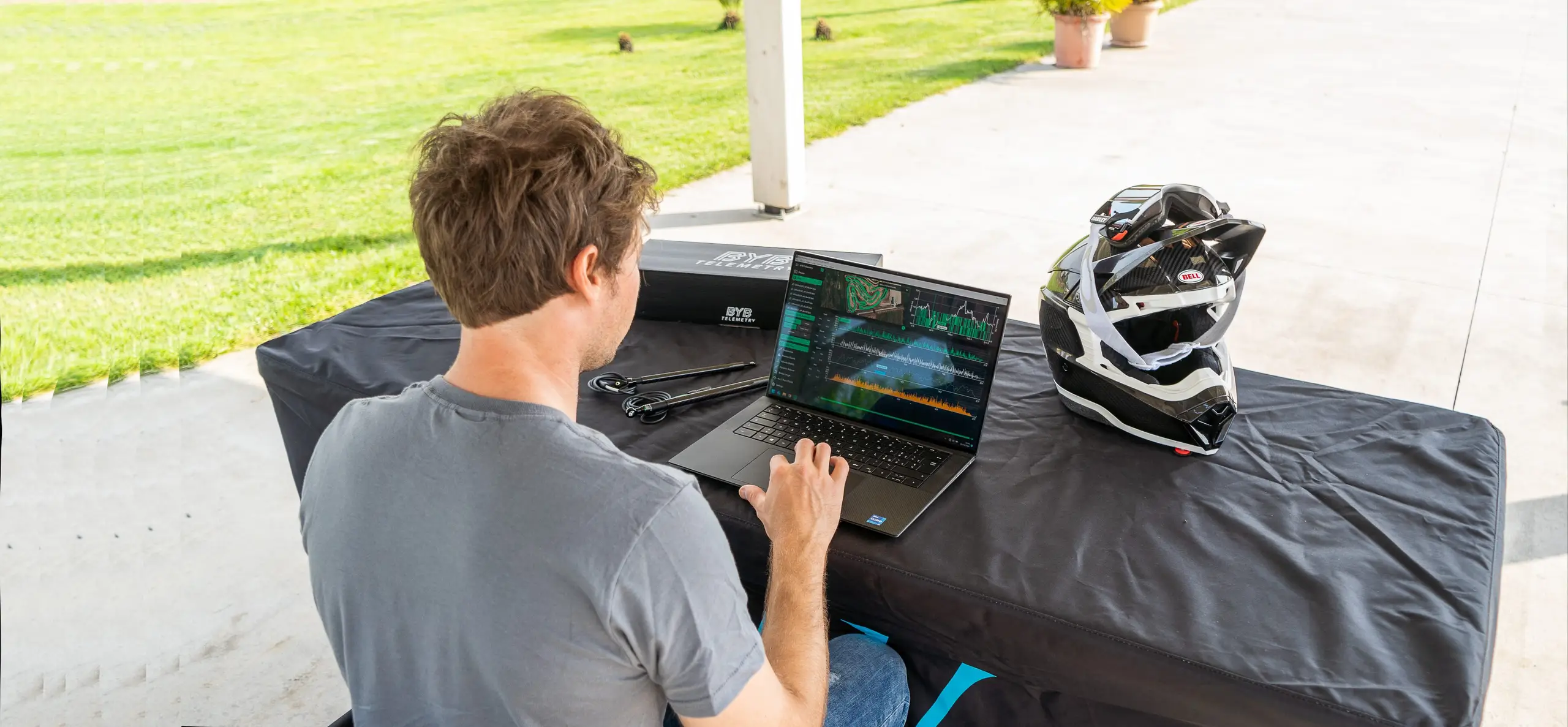
A supercross run recorded in Italy on 10 May 2025, at 1000 Hz on Telemetry V3 Pro, shows where the setup is loaded. The shock reached 70% of its stroke on the take-off ramp, deeper than anywhere else, and three tenths of a second later both ends read zero in the air.
| Measure | Fork | Shock |
|---|---|---|
| Deepest point of the run | 57% | 70% |
| Where it happened | After the second landing | On the take-off ramp |
Eleven seconds is one section, not a session. The value is in the comparison: the same section before and after one clicker change, read on the same axes. Motorcycle data acquisition covers what else such a recording holds.
Most BYB Points are mountain bike or motocross specialists. A session puts sensors on the fork and shock and records every run while the technician changes one thing at a time.
Common questions
- What is a good race sag for motocross?
- Motocross Action's rule of thumb is 100 mm. Precision Concepts, quoted by Dirt Bike, gives 100–108 mm for most modern bikes and 105–106 mm for closed-course motocross. Your model's owner's manual comes first.
- What should static sag be on a dirt bike?
- 30–40 mm on 125, 250 and 450 bikes, according to Motocross Action. More than 40 mm means the shock spring is too stiff; less than 30 mm means it is too soft.
- Is race sag the same as rider sag?
- Yes. Race sag, rider sag and riding sag all mean the drop with the rider on board in kit. Static sag, or free sag, is the drop under the bike's own weight.
- Can data acquisition be used on an enduro bike?
- Yes. BYB's motorcycle sensors are IP65, come in 350 mm lengths for the fork and 150 mm for the shock, and are used on motocross, enduro, supermoto, speedway and road bikes.