Motorcycle data acquisition: what it measures
Motorcycle data acquisition records what the suspension and chassis do while the bike is ridden: fork and shock position from linear sensors, acceleration and rotation from an inertial sensor, and on Telemetry V3 Pro also brakes, wheel speed and remote accelerometers. Sampled 500 (V3) or 1000 (V3 Pro) times a second, it turns a rider's feel into numbers.
Published
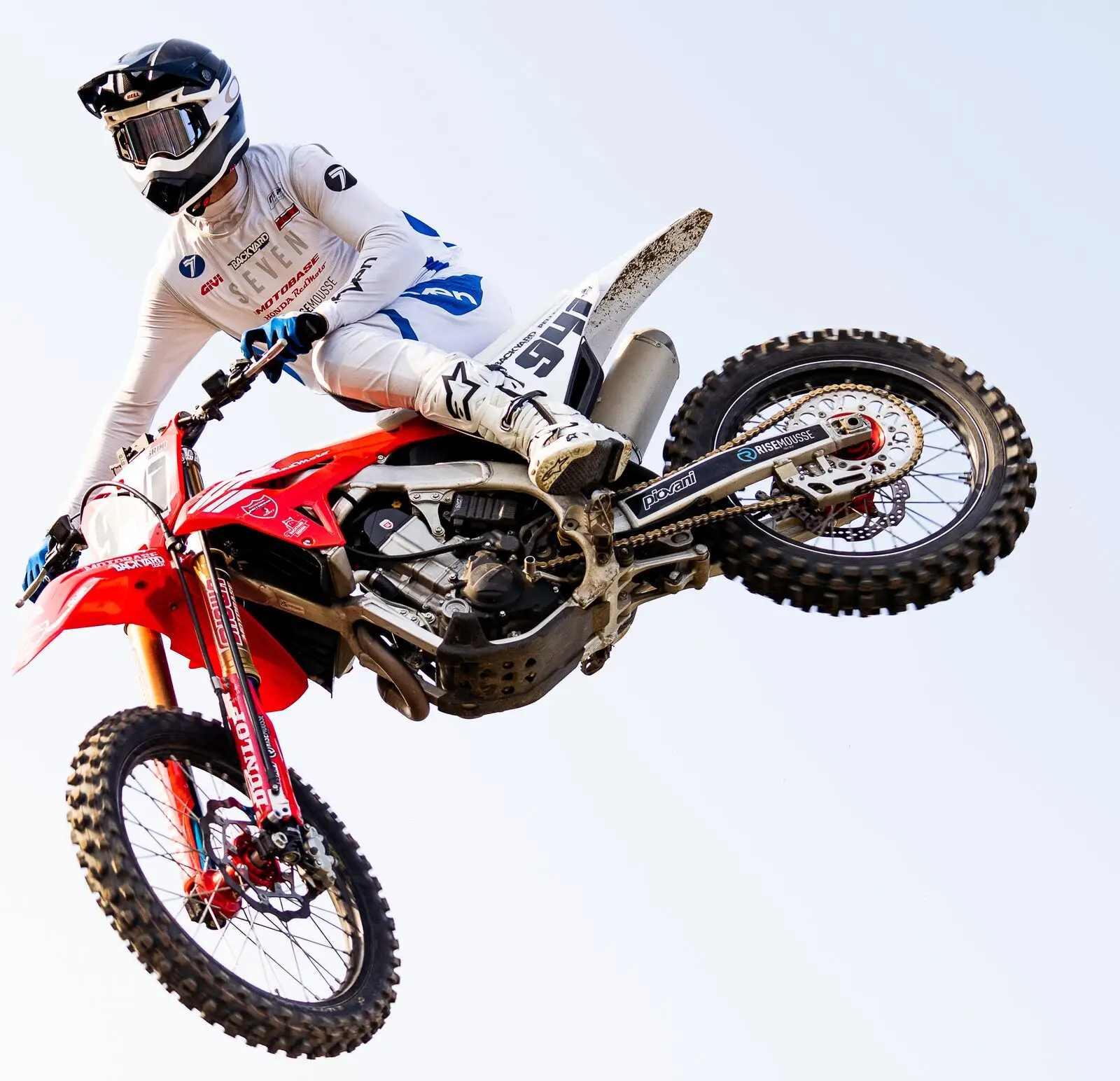
What motorcycle data acquisition measures
- Data acquisition
- Recording measurements from sensors on the motorcycle many times a second, then reading them back against time and distance. On a motorcycle the core measurement is fork and shock position.
- Fork and shock position: linear sensors, 350 mm long for the fork and 150 mm for the shock
- Acceleration and rotation: a built-in inertial sensor with 3 axes of each, on both units
- Braking: on or off from a digital sensor, how hard from an analog one, fitted without opening the hydraulic circuit (Telemetry V3 Pro)
- Wheel speed: read at the wheel rather than from GPS (Telemetry V3 Pro)
- Remote accelerometers at the axles, in 100 g and 200 g ranges (Telemetry V3 Pro)
- A wired trigger that marks a point on the track (Telemetry V3 Pro)
Position is the measurement everything else is read against. From it the software derives travel used, shaft speed and the balance between the two ends, the same analysis a mountain bike gets.
Why the sample rate matters on a motorcycle
Suspension speed reaches 10,000 mm/s on rough ground. A sensor read 50 times a second waits 20 ms between readings, and at that speed the shaft covers 200 mm in the gap: a whole hit can begin and end unseen.
Telemetry V3 samples at 500 Hz and Telemetry V3 Pro at 1000 Hz, one reading every 2 ms or every 1 ms. Draw-wire sensors lose the fastest hits for a mechanical reason: the spring that rewinds the wire cannot keep up at those speeds.
What a recorded motocross run looks like
A supercross run recorded in Italy on 10 May 2025, at 1000 Hz on Telemetry V3 Pro, holds 11,020 readings of each end in eleven seconds. Read in order, it is a sequence: the shock loads to 70% of its stroke on the take-off ramp, both ends read zero in the air, and the fork's deepest point, 57%, comes after the second landing.
Through the whoops that close the run, the shock averages 233% of its stroke per second and the fork 160%. Motocross and enduro suspension setup turns figures like these into clicker changes.
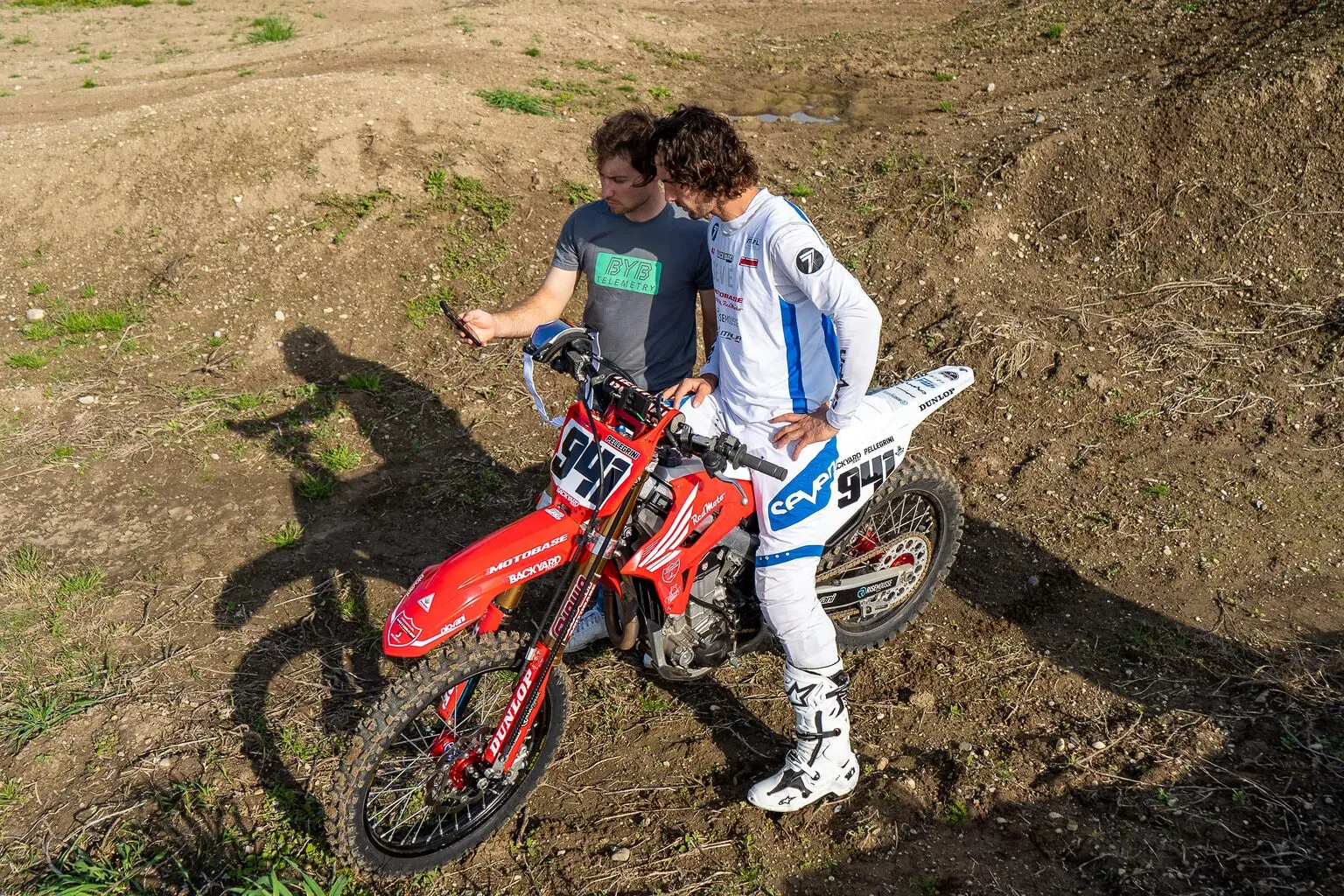
Which motorcycles it fits
The motorcycle kit is used on motocross, enduro, supermoto, speedway and road bikes, with IP65 sensors. Telemetry V3 fits mountain bikes and motocross; Telemetry V3 Pro also fits quads and cars, and maps its five channels to any sensor in its open mode.
Fitting typically takes under 15 minutes. There is no calibration routine: the unit zeroes itself while riding, and Telemetry V3 Pro can also take a manual zero. For lap times alongside the suspension data, a GPS lap timer answers a different question.
Telemetry V3 and Telemetry V3 Pro on a motorcycle
Both units weigh 80 g, record the inertial sensor and run the same suspension sensors. Telemetry V3 Pro adds three connectors and the brake, wheel speed and accelerometer channels a motorcycle team uses; kits and sensors are in the online store.
| Specification | Telemetry V3 | Telemetry V3 Pro |
|---|---|---|
| Sensor connectors | 2 | 5 |
| Sampling rate | 500 Hz | 1000 Hz |
| What it can record | Suspension | Suspension, brakes, pressure, remote accelerometers at the axles, a wired trigger to mark the track, and custom sensors |
| Built-in IMU (3-axis ±16 g, 3-axis ±1000 °/s) | Yes | Yes |
| Vehicle modes | MTB, Moto | MTB, Moto, Quad, Car, plus OPEN (custom non-BYB sensors) |
| Software and app | Included, with limited features | Included, every feature |
| BLE sensors (heart rate, power, cadence) | No | Yes |
| Custom channel mapping | No | Yes |
| Raw data export | No | Yes |
| Auto pause | Yes | Yes |
| Continuous sampling | +9h | +9h |
| Weight | 80 g · 2.8 oz | 80 g · 2.8 oz |
| Dimensions (with connectors) | 40×50×80 mm · 1.6×2.0×3.1 in | 40×50×80 mm · 1.6×2.0×3.1 in |
Common questions
- What does motorcycle data acquisition measure?
- Fork and shock position first, plus acceleration and rotation from a built-in inertial sensor. Telemetry V3 Pro adds brake sensors, wheel speed, remote accelerometers and a wired trigger.
- How fast does a motorcycle suspension sensor need to sample?
- Fast enough to catch a hit. At 10,000 mm/s a shaft moves 200 mm in the 20 ms a 50 Hz sensor waits between readings; Telemetry V3 reads every 2 ms and Telemetry V3 Pro every 1 ms.
- Does it work on an enduro or road motorcycle?
- Yes. The motorcycle kit is used on motocross, enduro, supermoto, speedway and road bikes, and its sensors are IP65.
- Do the sensors need calibrating?
- No routine is needed. The unit zeroes itself while riding, and Telemetry V3 Pro can also take a manual zero.