How GPS lap timers work for motocross and MTB
A GPS lap timer records the bike's position many times a second and times each lap when that position crosses a start-finish line set on a map. Chrono updates its multi-constellation GPS 25 times a second and lands times to the millisecond; coded triggers beside the track mark the line exactly where GPS reception is weak.
Published
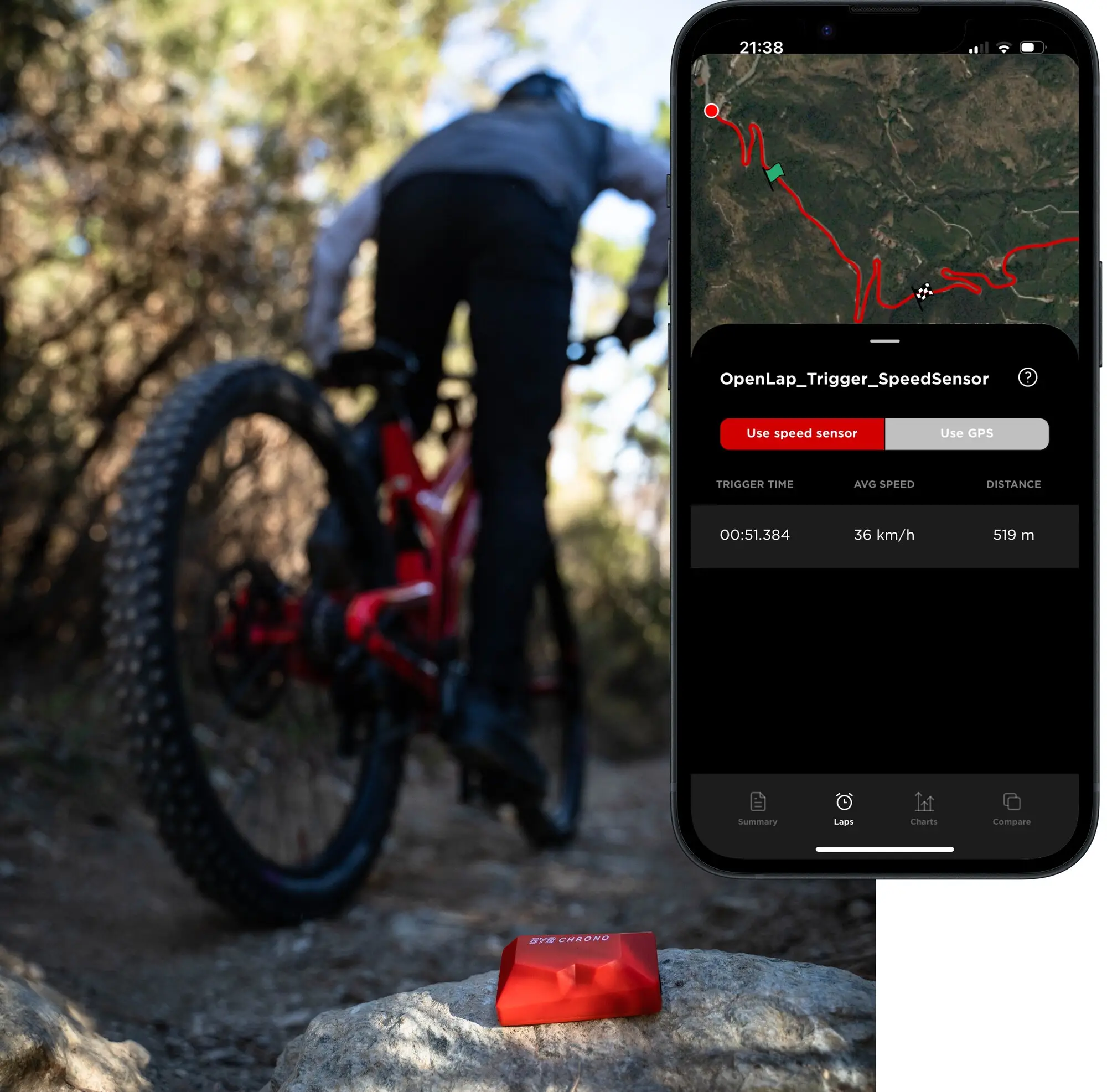
How a GPS lap timer works
- GPS lap timer
- A device that logs its own position from satellites and times a lap or a run each time it crosses a line you set, with nothing required at the track.
The update rate decides how finely the crossing is placed. Chrono's GPS updates 25 times a second, a fresh position every 40 ms, and it reports times to the millisecond: 00:51.384, not 00:51.4.
GPS-only timing versus trigger timing
| Configuration | Placed at the track | What it adds |
|---|---|---|
| GPS only | Nothing | Lap times, line and speed from satellites |
| GPS and speed sensor | Nothing | Distance and comparison under dense tree cover |
| GPS and external triggers | Coded triggers | Timing marked at the line itself |
| GPS, speed sensor and triggers | Coded triggers | Triggered timing, distance from the speed sensor and position for line analysis |
A trigger is a small red coded box placed beside the track, and it works like a transponder. Each carries its own code, so riders sharing a track never trigger each other's laps.
How many triggers a lap needs
- Closed lap, start and finish in one place: 1 trigger, timing every lap after the first
- Open lap, such as a downhill run or an enduro stage: 2 triggers, one at each end
- GPS waypoint lap: 0 triggers, with splits dropped on the map
- Every trigger beyond the minimum times a split, to a maximum of 10
Splits drawn on the map need no hardware at all. A trigger added later times a split alongside them in the same session.
Why tree cover changes the answer
A wooded descent is where GPS reception degrades and where accurate distance matters most, because comparing two laps means comparing them at the same point on the track. Chrono's built-in speed sensor carries distance and comparison through those sections.
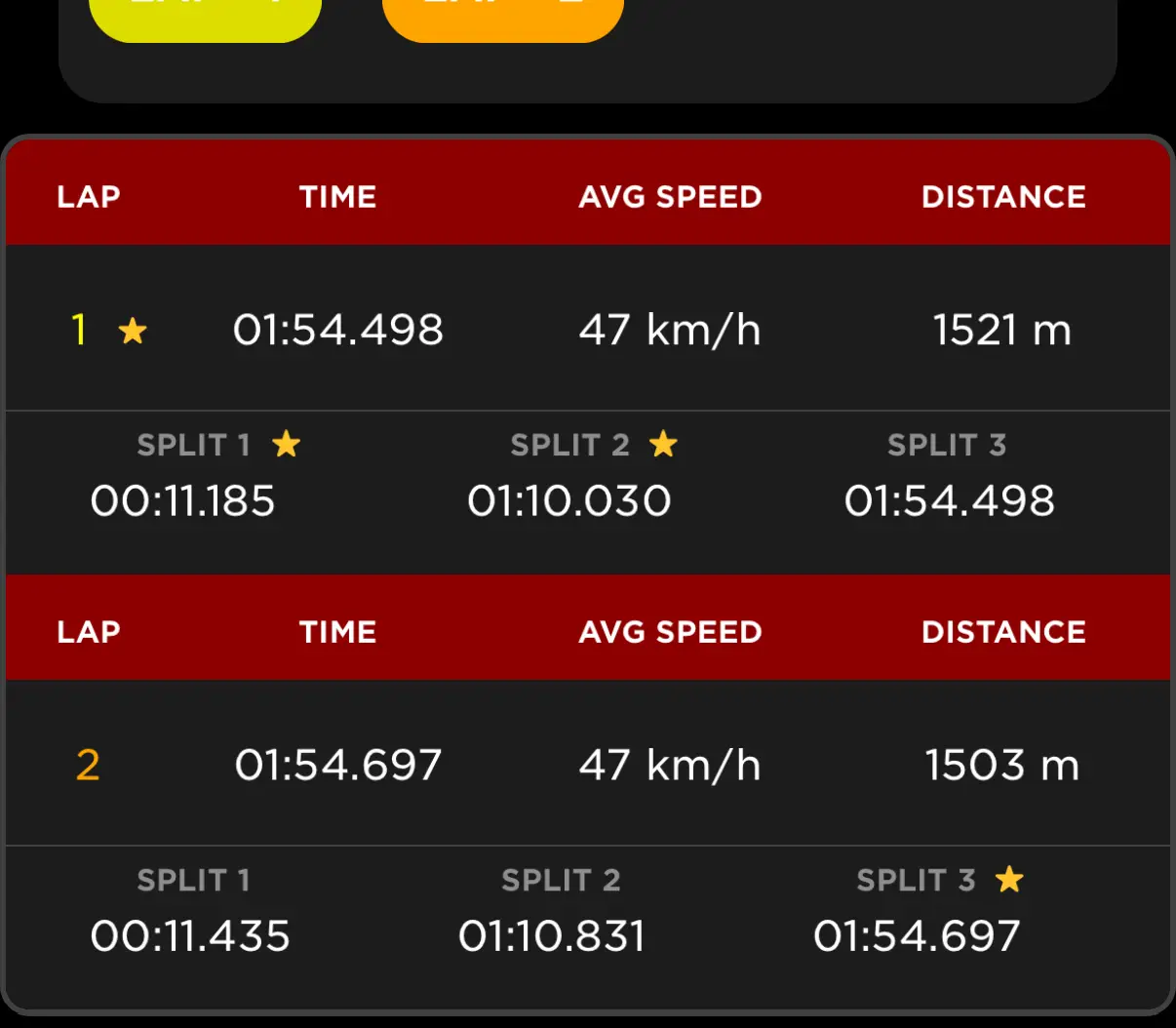
Splits are what turn a lap time into a decision. Without them, the two laps above are 0.199 s apart; with them, most of the time is visibly lost in the middle sector and partly recovered at the end.
What a lap timer measures and what it does not
Chrono reports lap and run times with total and moving time kept apart, splits, the delta between two runs, the ridden line with entry and exit speed, and a braking and acceleration map. Its app runs on iOS and Android phones and tablets with no extra fees.
A lap timer does not measure the suspension. What the fork and shock did through a run is suspension data acquisition, recorded by Telemetry V3 and Telemetry V3 Pro, and many riders run both.
Common questions
- How accurate is a GPS lap timer?
- Chrono lands times to the millisecond from a GPS that updates 25 times a second. With coded triggers at the line, timing is more accurate than GPS-only, because it no longer depends on position or reception.
- Do I need triggers to time laps?
- No. Chrono times a lap on GPS alone. Triggers are optional: one for a closed lap, two for an open lap, and each extra one times a split.
- Can a GPS lap timer time a downhill run or an enduro stage?
- Yes. Both are open laps, with the start and finish in different places, timed on GPS alone or with two triggers, one at each end. It works on a mountain bike and on an enduro motorcycle.
- Do riders on the same track interfere with each other's triggers?
- No. Each trigger carries its own code, so every rider's timing stays their own.