Compression and rebound: high and low speed
High and low speed in compression and rebound refer to how fast the suspension shaft moves, not how fast the bike goes. Low-speed circuits control slow movements such as berms, weight shifts and small bumps; high-speed circuits control sharp hits such as roots, rocks and drops. Rebound sets how quickly the suspension extends again.
Published
What high and low speed mean in suspension damping
- Shaft speed
- How fast a fork or shock is compressing or extending, in millimetres per second. Damping circuits are named after this speed, never after the speed of the bike.
Suspension speed reaches 10,000 mm/s on rough ground, while a push into a berm moves the shaft at a small fraction of that. One damper has to control both, which is why many forks and shocks split compression into a low-speed and a high-speed circuit.
| Adjustment | What it controls | Where you feel it |
|---|---|---|
| Low-speed compression | Slow compression | Berms, weight shifts, small bumps |
| High-speed compression | Fast compression | Square-edge rock gardens, roots, drops |
| Rebound | How quickly the suspension extends | Every movement back toward full extension |
Some dampers also split rebound into a low-speed and a high-speed circuit. The BYB Telemetry software reads all four, which is how the speed zones below are drawn.
How suspension speed data shows each circuit at work
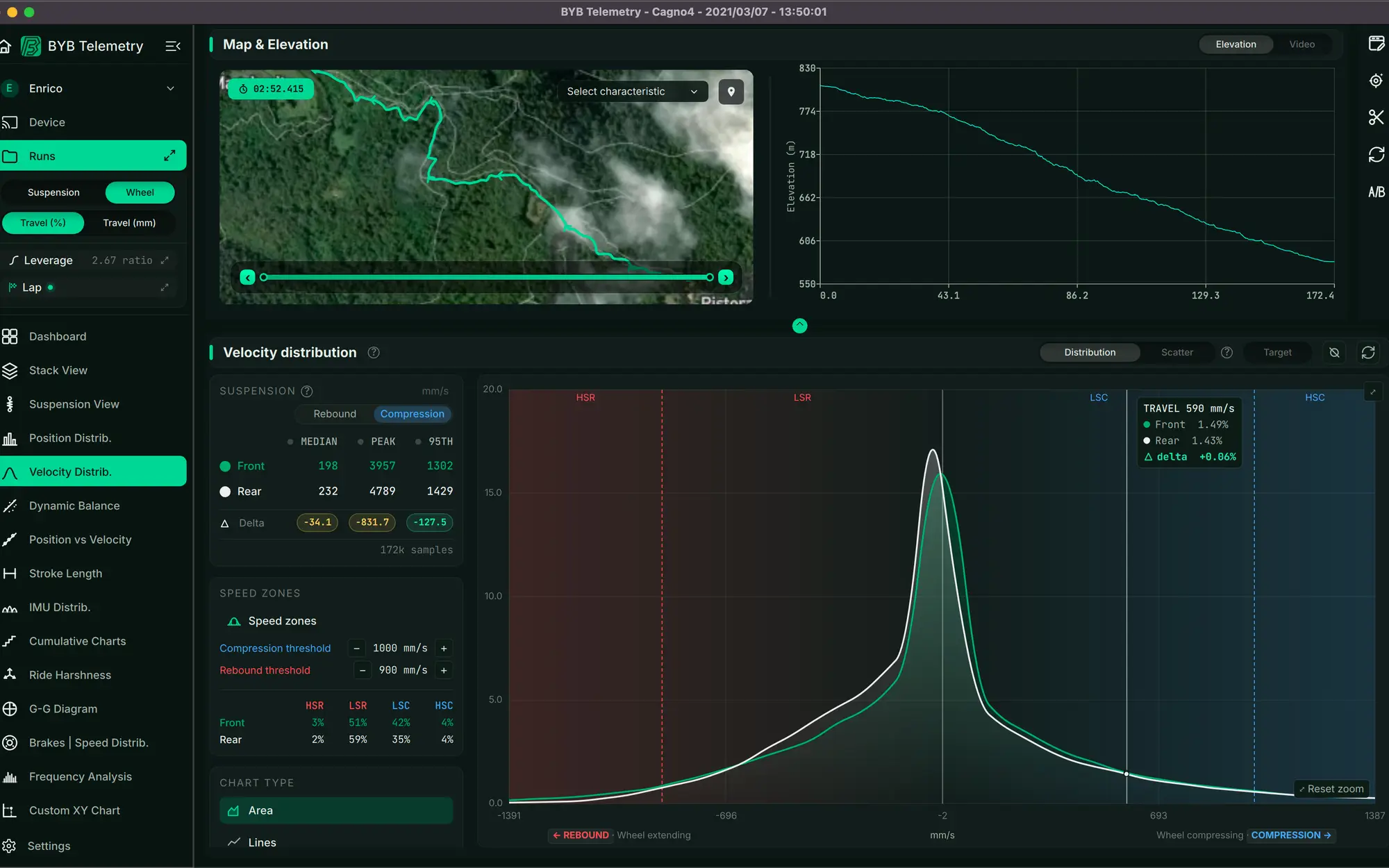
A velocity distribution plots how much of a run the suspension spent at each speed, rebound to the left of zero and compression to the right. Thresholds split it into four zones, one per circuit; the panel shown reads speed at the wheel, and the same view switches to the shafts.
| Speed zone | Front | Rear |
|---|---|---|
| High-speed rebound | 3% | 2% |
| Low-speed rebound | 51% | 59% |
| Low-speed compression | 42% | 35% |
| High-speed compression | 4% | 4% |
Most of the run is slow movement. The same panel puts the median compression speed at the wheel at 198 mm/s front and 232 mm/s rear, and the 95th percentile at 1302 and 1429 mm/s: the hits that decide a high-speed setting are rare and fast.
The thresholds are a setting in the software, not a law. A damper responds to its own shaft speed, which the leverage ratio separates from wheel speed at the rear, and where its high-speed circuit starts depends on its valving: the zones compare runs on the same bike, not one bike with another.
Compression speed and rebound speed compared
An impact can drive the suspension in faster than the spring can push it back out. On a descent at Livigno recorded on 18 July 2026, the shock's fastest 5% of compression ran above 741% of its stroke per second, against 301% for its fastest 5% of rebound; the fork's were closer, 568% against 525%.
Motocross whoops load the rear. Across 7.0 to 10.5 seconds of a supercross run recorded in Italy on 10 May 2025, the shock averaged 233% of its stroke per second against the fork's 160%.
How to adjust compression and rebound one click at a time
- Set sag first, because damping is tuned around where the suspension sits
- Start from the manufacturer's rebound and compression suggestion, counted in clicks from fully closed
- Change one circuit only: 1–2 clicks of rebound or high-speed compression, or 2–3 clicks of low-speed compression
- Ride the same section at the same effort
- Compare the two runs, then keep the change or undo it
On RockShox dampers, turning a knob clockwise adds damping and counterclockwise removes it; for rebound, clockwise is toward the turtle and slows the return. Sag itself is covered in how to measure sag on a mountain bike.
What auto tuning suggests from the same run
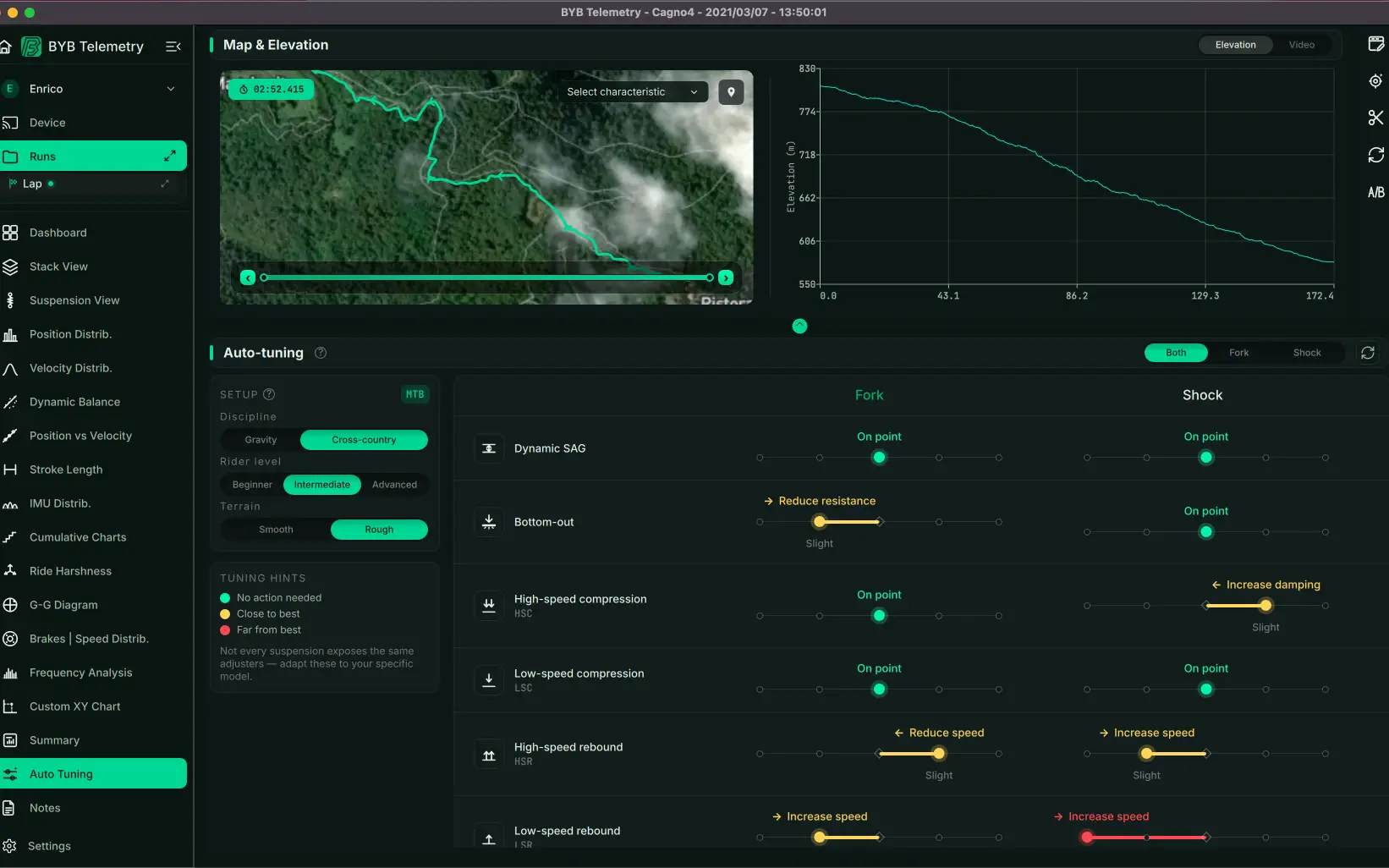
Auto tuning proposes a direction for each adjuster, fork and shock alike, from the measured run, the rider's level and the terrain. You make the change, ride again, and the next run shows whether it worked.
Common questions
- What is the difference between high-speed and low-speed compression?
- The speed of the shaft, not of the bike. Low-speed compression controls slow movements such as berms and weight shifts; high-speed compression controls sharp hits such as roots, square-edge rocks and drops.
- Should I adjust compression or rebound first?
- Rebound, after sag. RockShox's setup order sets the air spring's starting pressure, then rebound, then compression. Rebound decides how much travel is back in place for the next hit, so compression is judged after it.
- How do I know if rebound is too slow?
- Rebound that is too slow cannot return before the next bump, so across a series of hits the suspension sits deeper and deeper in its travel. A recorded run shows that as position climbing through a rough section.
- Can data acquisition measure damping?
- It measures what damping does. Position sampled at 500 Hz on Telemetry V3 or 1000 Hz on Telemetry V3 Pro gives shaft speed as well, which is what the velocity distribution and auto tuning read.